Wimborne Nourishing Stout
George Habgood (1857-1946) was Initiated into the Lodge of St. Cuthberga in April 1881 and became the Master in 1891.
He followed on to become Director of Ceremonies in 1893-98, 1916-20, and again in 1923. He was Almoner in 1931. His duties to Freemasonry were recognised when the Province of Dorset awarded him with PGStdB in 1892, PSGW in 1912, and PG Treasurer in 1924, which he held until 1933. Grand Lodge Appointed him to PAGDC in 1928. He became Provincial Grand Mark Master in 1928. When he died in 1946, he was one month short of 65 years of 622 membership.
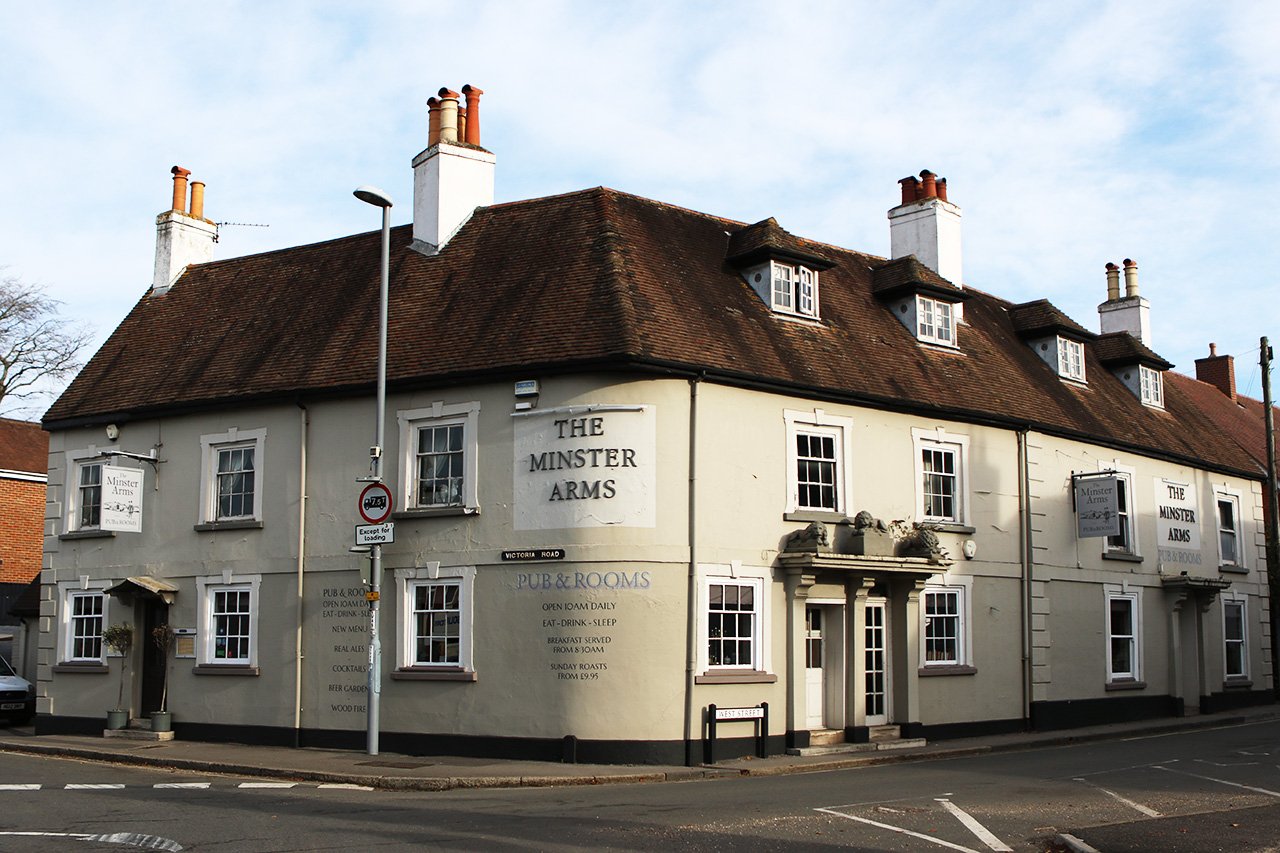
George Habgood was married with 4 children. In his working life he had taken over the running of his father’s Julian Brewery in Wimborne – George Habgood & Son Ltd. This was located behind the Three Lions public house (now the Minster Arms) at Pye Corner, #Wimborne.
By 1876, the firm employed 6 men and a boy and it became necessary to build a new Brewery on the site owing to the expansion of the firm. Habgood’s beers became more and more popular, especially his Light Family Ale sold for One Shilling a gallon, and his Wimborne Nourishing Stout. In 1915, although George Habgood retained some of the business for his family, he sold the main part to Groves & Sons Ltd, from Weymouth.
From details supplied by the Dead Brewer’s Society, Groves acquired these 17 premises in this sale:
The Yacht Inn, Market Street, Poole £1,000 (Renamed Guildhall Tavern 1971)
The Coventry Arms, Corfe Mullen £1,000
The Railway Hotel, Station Road, West Moors £1,000 (Renamed Mariners Rest 1971)
The London Brewery (off-licence & brewhouse), Christchurch – £700
The Pinecliff Hotel, Seabourne Road, Southbourne, Bournemouth – £4,300
The George Inn, Cornmarket, Wimborne £700 (Now a private house)
The Greyhound Inn, Poole Street, Wimborne £800
The Cricketers Arms, Park Lane, Wimborne £
The White Horse, West Quay Road, Poole (Demolished due to High Street redevelopment in late 1960s/early 1970s)
The Barley Mow Inn, Colehill, near Wimborne
The Bear Cross Hotel, Kinson, Bournemouth
The Stocks Inn, Furzehill, near Wimborne
The Gold Oak, Cranborne
The Horns Inn, West Parley, near Ferndown
The Cross Keys Inn, Mannington, near Cranborne
The Dorset House, Moordown, Bournemouth
Julian House, 2 Nursery Road, Moordown, Bournemouth (Off-licence & depot)
The Julian Brewery itself was sold for £16,000 and all of its equipment for £150. The beer casks and dray horses were sold for £1,000.
George Habgood retained the Three Lions at Pye Corner and the Oddfellows Arms in Wimborne, as they were his family’s original business premises. He also retained the #Haven Hotel at Sandbanks, having realised its future potential with the growing interests in holidays and day-excursions.
However, road access to Sandbanks was poor and although it had become popular as the seaside place for Poole, it was said that ‘people were jolted out of their lives before they got down there’. The beaches were becoming more heavily visited and the Haven Hotel had become a wonderful place for a ‘nice cup of tea’. George Habgood realised that something needed to be done.
In 1898, he sponsored the building of a pier 92ft. long by 26ft. wide, which was large enough to allow passenger steamers to call at Sandbanks and the Hotel.
On the day of the Grand Opening, passengers were brought from Poole on board the S.S. Lord Elgin. The ceremony was conducted by the Mayor of Poole, and this was followed by a luncheon in the Hotel hosted by George Habgood, who took the opportunity to stress to the Town Council the need for better access and roads to this important area.
Soon afterwards, the Haven Hotel became the site of a cutting-edge experiment. The young Italian inventor, Guglielmo #Marconi had arrived in England in 1896 and won support for his investigations into the new wireless telegraphy. His first transmitting station was at the Royal Needles Hotel on the Isle of Wight, followed by stations at Bournemouth and Swanage.
In September 1898, he arrived at the Haven Hotel with masts and apparatus and set up his laboratory in an east-facing room on the ground floor.
One of Marconi’s assistants, Mr. H.M. Dowsett, recalled the wireless room as ‘a business workshop, full of purposeful activity and with signals being continuously exchanged between the Needles station 14 miles away.’
By 1899, it was reported in the press that ‘Marconi’s wireless telegraphy is now far beyond the experimental stage and recent trials of its practical utility have been crowned with success. Recently one of the stations has been removed to the Haven Hotel, Poole, and the signalling distance has increased to eighteen miles.’
Marconi continued to work at the Hotel until 1926. When he was in residence there, convivial meals and evenings were held with his family, assistants, fellow scientists and other visitors, which were followed by music and singing, with Guglielmo on the piano and his brother Alfonso playing the cello.
One might wonder how much of this exciting new technology was discussed between George Habgood and his fellow Brethren on a Lodge night!
David Smith
Lodge of St Cuthberga 622
